
PicoScope Oscilloscopes – USB Oscilloscopes for Development, Service and Lab Use
At PSE, you will find PicoScope USB oscilloscopes for a wide range of requirements – from compact entry-level instruments for education and mobile service to powerful PC oscilloscopes for demanding development and laboratory applications. Depending on the model, different bandwidths, sampling rates, memory depths, channel counts, MSO functions and integrated signal generators are available.
- SKU:
- PQ344
- 4 channels with 50 Ohm inputs
- 4 input ranges per channel (±50mV, ±100mV, ±200mV, ±500mV)
- Up to 3GHz bandwidth
- 100 ps time resolution
- 4 GS capture memory
- Up to 10GS/s real-time sampling
- 8-, 10-, or 12-bit flexible resolution (FlexRes)
- Segmented memory/rapid block trigger
- Built-in function generator/AWG
- Use as a mixed signal oscilloscope via optional MSO pods
- Fast transfer of captured data to the host computer via the USB 3.0 SuperSpeed connection
- Drivers and SDK included (Windows, Linux, Mac)
- Programming examples for LabView, MATLAB, Python and C++
- PicoScope software included
- SKU:
- PQ341
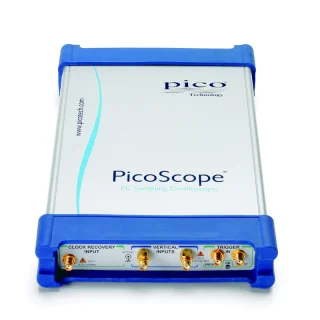
- SKU:
- PQ340
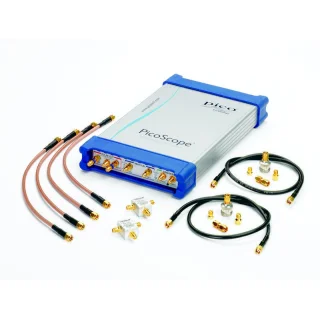
- SKU:
- PQ091
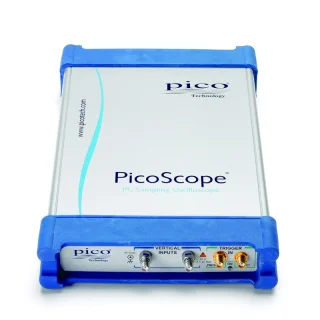
- SKU:
- PQ339
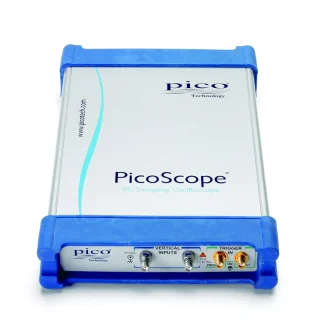
- SKU:
- PQ338
- SKU:
- PQ303
- 4 channels plus 16 high performance digital channels (MSO)
- Deep memory: up to 4GS
- Resolution: FlexRes® 8-12 bits
- Fast sampling speeds and USB 3.0 connectivity
- High bandwidth: 1GHz
- Performance and functionality for debugging next generation embedded systems
- New optional accessories - industry leading probe holder system
- Better display performance and visualization tools - support for the latest 4K UHD displays
- 300 000 waveforms per second update rate
- Free PicoScope 6, PicoLog6 and PicoSDK software
- Serial bus decoding (21 protocols) and mask limit testing
- High-resolution time-stamping of waveforms
- Over ten million DeepMeasureTM results per acquisition
- Advanced triggers: pulse width, runt pulse, windowed, logic and dropout
- Supplied with 4 x P2056 500MHz scope probes, 10:1
- SKU:
- PQ302
- 4 channels plus 16 high performance digital channels (MSO)
- Deep memory: up to 4GS
- Resolution: FlexRes® 8-12 bits
- Fast sampling speeds and USB 3.0 connectivity
- High bandwidth: 750MHz
- Performance and functionality for debugging next generation embedded systems
- New optional accessories - industry leading probe holder system
- Better display performance and visualization tools - support for the latest 4K UHD displays
- 300 000 waveforms per second update rate
- Free PicoScope 6, PicoLog6 and PicoSDK software
- Serial bus decoding (21 protocols) and mask limit testing
- High-resolution time-stamping of waveforms
- Over ten million DeepMeasureTM results per acquisition
- Advanced triggers: pulse width, runt pulse, windowed, logic and dropout
- SKU:
- PQ301
- 4 channels plus 16 high performance digital channels (MSO)
- Deep memory: up to 2GS
- Resolution: 8 bit
- Fast sampling speeds and USB 3.0 connectivity
- High bandwidth: 1GHz
- Performance and functionality for debugging next generation embedded systems
- New optional accessories - industry leading probe holder system
- Better display performance and visualization tools - support for the latest 4K UHD displays
- 300 000 waveforms per second update rate
- Free PicoScope 6, PicoLog 6 and PicoSDK software
- Serial bus decoding (21 protocols) and mask limit testing
- High-resolution time-stamping of waveforms
- Over ten million DeepMeasureTM results per acquisition
- Advanced triggers: pulse width, runt pulse, windowed, logic and dropout
- SKU:
- PQ300
- 4 channels plus 16 high performance digital channels (MSO)
- Deep memory: up to 2GS
- Resolution: 8 bit
- Fast sampling speeds and USB 3.0 connectivity
- High bandwidth: 750MHz
- Performance and functionality for debugging next generation embedded systems
- New optional accessories - industry leading probe holder system
- Better display performance and visualization tools - support for the latest 4K UHD displays
- 300 000 waveforms per second update rate
- Free PicoScope 6, PicoLog 6 and PicoSDK software
- Serial bus decoding (21 protocols) and mask limit testing
- High-resolution time-stamping of waveforms
- Over ten million DeepMeasureTM results per acquisition
- Advanced triggers: pulse width, runt pulse, windowed, logic and dropout
Please send a message to priggen@priggen.com
FAQ PicoScope Oszilloscopes
What is a PicoScope oscilloscope?
A PicoScope is a PC-based USB oscilloscope from Pico Technology. The measuring instrument is connected to a computer via USB and operated using the PicoScope software. The computer acts as the display, control and analysis platform.
The advantage is the combination of compact hardware and powerful software. Measurement signals can be displayed on a large screen, saved, documented, exported and analysed using various software functions. This makes PicoScope oscilloscopes suitable for development, service, education, mobile measurements and laboratory applications.
What are the advantages of a PicoScope compared with a traditional benchtop oscilloscope?
A PicoScope requires significantly less space than a traditional benchtop oscilloscope and can be operated easily with a notebook or PC. This is especially practical for mobile use, small workstations, training rooms or flexible laboratory environments.
The PC-based operation also offers advantages for documentation and analysis. Measurement data can be saved, processed and included in reports more easily. Depending on the model, additional software functions such as spectrum analysis, serial protocol decoding, function generator, AWG or logic analysis are available.
What applications are PicoScope USB oscilloscopes suitable for?
PicoScope USB oscilloscopes are suitable for many measurement tasks in electronics, electrical engineering, development, service and education. Typical applications include the analysis of sensor signals, microcontroller circuits, PWM signals, clock lines, power supplies, amplifiers, filters, control systems and communication signals.
Depending on the model, PicoScope oscilloscopes can also be used for serial protocols, digital signals, mixed-signal analysis, long recordings or high-resolution measurements. This makes them useful for both beginners and professional users in laboratories and test environments.
Which PicoScope is right for my application?
The right PicoScope depends mainly on bandwidth, sampling rate, memory depth, number of channels and the required features. For simple measurements, education, hobby use and mobile service, compact models from the PicoScope 2000 Series are often sufficient.
For development, laboratory use and more demanding measurements, models from the PicoScope 3000 Series or higher are often the better choice. If several digital signals need to be analysed in addition to analogue channels, an MSO model with logic analysis capability can be useful. For particularly precise measurements, resolution and memory depth are also important selection criteria.
What is the difference between 2-channel, 4-channel and MSO PicoScopes?
A 2-channel PicoScope has two analogue input channels and is suitable for many standard measurements, such as comparing the input and output of a circuit. A 4-channel PicoScope offers more flexibility when several signals need to be viewed at the same time.
MSO stands for Mixed Signal Oscilloscope. An MSO PicoScope combines analogue oscilloscope channels with additional digital inputs. This is particularly useful for microcontroller circuits, digital control systems, bus signals or the parallel analysis of analogue and digital signals.
Why are bandwidth, sampling rate and memory depth important?
Bandwidth indicates the frequency range in which an oscilloscope can meaningfully capture signals. The sampling rate describes how many measurement points are recorded per second. Memory depth determines how many measurement points can be stored in one acquisition.
For slow signals, a simpler model is often sufficient. For fast signal edges, digital circuits, serial interfaces or longer recordings, higher bandwidth, higher sampling rate and deeper memory are important. Deep memory is especially helpful when long time windows need to be recorded with high resolution.
Which software is used with PicoScope oscilloscopes?
PicoScope oscilloscopes are operated using the PicoScope software. The software enables signal display, measurement and analysis directly on the computer. Depending on the device and software version, functions such as oscilloscope display, spectrum analysis, measurements, triggering, serial decoders, function generator, AWG and logic analysis on MSO models are available.
A key advantage of the software-based approach is convenient operation via the PC. Measurement data can be saved, exported and documented, which is particularly useful in development, quality assurance, education and service.
Can a PicoScope analyse serial protocols?
Yes, many PicoScope applications support serial protocol analysis using the PicoScope software. This is especially helpful when troubleshooting microcontroller circuits, embedded systems and communication interfaces.
Protocol decoding allows electrical signals and data content to be viewed together in time. This makes it easier to identify transmission errors, timing problems or signal quality issues. The available protocols and functions depend on the PicoScope model and software version used.
Do I need a separate power supply for a PicoScope?
Many PicoScope models are powered directly via USB and do not require a separate power supply. This makes them particularly compact and mobile. They can be connected easily to a notebook or PC and used at different workstations.
For more powerful models or special device series, power supply requirements may vary depending on the configuration. Before purchasing, it is therefore advisable to check the connections and requirements of the specific PicoScope model.
What should I consider when buying a PicoScope?
When buying a PicoScope, you should first determine which signals you need to measure. Important selection criteria include bandwidth, sampling rate, memory depth, number of channels, resolution, MSO capability, signal generator/AWG and supported software functions.
For simple measurements and education, a compact entry-level model is often sufficient. For professional development, fast signals, serial protocols or longer measurement recordings, a more powerful model with higher bandwidth and deeper memory is recommended. If you are unsure which PicoScope is suitable for your application, technical advice before purchase is recommended.
- Available
-
: 1 - 3 Workdays (DE - int. shipments may differ)
PicoScope Oszilloskope von Pico Technology sind eine moderne Alternative zu klassischen Tisch-Oszilloskopen. Die Geräte werden per USB mit einem Computer verbunden und über die PicoScope Software bedient. Dadurch profitieren Anwender von einer großen Bildschirmdarstellung, einfacher Speicherung von Messdaten, komfortabler Dokumentation und umfangreichen Analysefunktionen.
Ein PicoScope eignet sich für viele typische Anwendungen in Elektronik, Entwicklung, Service und Ausbildung. Dazu gehören Messungen an Sensorsignalen, Mikrocontroller-Schaltungen, PWM-Signalen, Takt- und Steuersignalen, Netzteilen, Verstärkern, Filtern, seriellen Schnittstellen und digitalen Baugruppen. Je nach Modellreihe sind PicoScope Oszilloskope als 2-Kanal-, 4-Kanal- oder Mixed-Signal-Oszilloskope erhältlich.
Die PicoScope 2000 Serie eignet sich besonders für Ausbildung, Hobby, mobilen Service und kompakte Messplätze.
Die PicoScope 3000 Serie ist eine vielseitige Lösung für allgemeine Anwendungen in Entwicklung und Labor.
Für höhere Auflösung, mehrere Kanäle oder besonders anspruchsvolle Messaufgaben stehen weitere Serien wie PicoScope 4000, 5000 oder 6000 zur Verfügung.
Ein großer Vorteil der PicoScope USB-Oszilloskope ist die leistungsfähige Software. Je nach Modell und Ausstattung lassen sich Signale nicht nur anzeigen, sondern auch messen, analysieren, speichern, exportieren und mit Zusatzfunktionen wie Spektrumanalyse, Funktionsgenerator, AWG, serieller Protokolldecodierung oder Logikanalyse auswerten.
Wenn Sie ein PicoScope kaufen möchten, sollten Sie vor allem auf Bandbreite, Abtastrate, Speichertiefe, Kanalzahl, Auflösung und die benötigten Softwarefunktionen achten. Für einfache Messaufgaben genügt häufig ein kompaktes Einstiegsmodell. Für professionelle Entwicklung, serielle Analysen, längere Aufzeichnungen oder schnelle Signale empfiehlt sich ein leistungsstärkeres PicoScope mit größerem Speicher und höherer Bandbreite.