
Air & Gas Measuring Instruments for Air Quality & Gas Monitoring – CO₂ Monitors, Gas Detectors & Sensors
- SKU:
- OEM-O3
- Variations in:
-
- Range
The Eco Sensors OEM-O3 is a user-replaceable ozone sensor module for OEM, service and integration applications. It is available with 0.1 ppm, 1.0 ppm or 10.0 ppm output options and provides both digital UART communication and a buffered 0-2 V analog output.
- SKU:
- PMsenseCR_ff
- Variations in:
-
- Variant:
- Item weight:
- 0,33 kg
- Particularly suitable for controlled environments, clean room
- Excellent long term performance
- Particulate matter output & optional CO2 output
- Modbus-RTU and Modbus + two 4-20mA output variants
- According to ISO 14644 cleanroom standards
- SKU:
- P5170
- SKU:
- SM-500/RME
- Seamless integration with the OS-4 and OS-6 ozone controllers from Eco Sensors
- Includes a user-replaceable calibrated sensor module (RME), allowing users to easily meet calibration requirements
- Integrated zero-reset button for recalibrating the sensor module during operation
- Available with standard calibration ranges of 0–20 ppm and 1–50 ppm
- USB Micro-B port for optional power supply and serial communication
- Convenient data configurations: RS-232 transmission and 0–2 V buffered analog output
- Temperature and relative humidity sensor data included in the digital output
- SKU:
- DT-326
- Display of carbon dioxide concentration, air temperature and humidity
- Rating as GOOD, NORMAL or POOR
- Measuring ranges:
CO2: 0-5000ppmTemperature: -10 to +50°CAir humidity: 0 to 100% RH
- Adjustable alarm
- SKU:
- AIC3
- Dual polarity display with sum
- Selectable ranges, 2 million ions/cc, or 200 million ions/cc
- Data recording, date/time Stamped – Stored on removable microSD card
- Data streaming, record uploading and plotting – via included PC app
- Automatic re-zero for long-term unattended operation – selectable
- Peak level capture
- Averaging – selectable
- Rechargeable Li battery
- Robust metal housing
- Tripod mount, wall mount, and desk top kick stand
- Deluxe carrying case
- SKU:
- GOEL370
Replacement sensor for GHM Greisinger oxygen instruments.
- SKU:
- GOEL381
Replacement sensor for GHM Greisinger oxygen instruments.
- SKU:
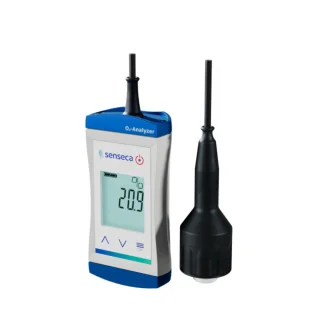
- ECO410-35
- 0-100 vol. % O2, recommended for 0.2 to 35.0%
- modern & functional - pocked size
- waterproof IP65 and IP67
- comfortable air adjustment at push of button
- 3-line display with backlight/ overhead display at push of button
- SKU:
- ECO410T-35
- Sport diver version "T" with MOD calculation for Nitrox
- 0.0-100 vol. % O2, recommended for 0.2 to 35.0%
- modern & functional - pocked size
- waterproof IP65 and IP67
- comfortable air adjustment at push of button
Please send a message to priggen@priggen.com
What types of air and gas measuring instruments does PSE Priggen offer?
We offer various air and gas measuring instruments such as CO₂ monitors, air quality meters, portable gas detectors, radon monitors, VOC detectors as well as stationary sensors for CO₂, CO, O₂ and other gases. In addition, you will find instruments for air sampling, flow measurement and weather & climate monitoring.
Which gases and parameters can your air and gas instruments measure?
Depending on the instrument, they can measure CO₂, CO, O₂, ozone, VOCs, radon and other gases and airborne pollutants. Many devices also record temperature and humidity to provide a comprehensive assessment of indoor air quality. The exact measuring parameters are listed in each product description.
What is the difference between an air quality meter and a gas detector?
Air quality meters are mainly used to assess indoor air, e.g. CO₂ level, temperature, humidity and sometimes particulate matter or VOCs, often including trend graphs and threshold warnings. Gas detectors are primarily safety-related devices that give clear alarms when limit values are exceeded (e.g. CO, oxygen deficiency, flammable gases) and can be integrated into safety systems.
For which applications are PSE Priggen’s air and gas instruments suitable?
Our instruments are used in offices, schools, public buildings, industrial plants, laboratories, production areas as well as in building biology and environmental applications. Typical tasks include monitoring indoor air quality, controlling CO₂ levels, detecting hazardous substances and supporting occupational health and safety measures.
Do you offer both portable and stationary air or gas measuring instruments?
Yes, we supply portable handheld instruments for mobile measurements and spot checks, as well as stationary sensors and monitors for continuous monitoring of rooms or processes. Some models feature data logging capabilities, PC or network interfaces and alarm/relay outputs to control ventilation or warning systems.
Do air and gas measuring instruments require regular calibration?
Regular calibration or function checks are recommended for reliable readings, especially for safety-related gas detectors. The recommended intervals depend on the device type, application and manufacturer’s specifications. The technical data and manuals provide information on calibration – we will be happy to help you choose suitable instruments and calibration services.
What should I consider when selecting an air or gas measuring instrument?
Key criteria include the gases/parameters to be measured, measuring range, accuracy, response time, operating environment (indoor, industrial, possibly hazardous area), mounting type (portable or stationary) and required interfaces and alarm functions. If you briefly describe your measurement task, we will recommend suitable instruments and accessories.
Can you support me in planning an indoor air or gas monitoring solution?
Yes, we are happy to assist you in selecting suitable instruments and sensors for your application – from simple CO₂ room monitoring to combined solutions with several sensors. If desired, we take into account room size, number of occupants, ventilation concept and safety requirements and recommend a technically sound and cost-effective solution.
- Available
-
: 11 - 13 Workdays (DE - int. shipments may differ)
- Available
-
: 8 - 10 Workdays (DE - int. shipments may differ)
- Available
-
: 11 - 13 Workdays (DE - int. shipments may differ)
- Available
-
: 11 - 13 Workdays (DE - int. shipments may differ)
- Available
-
: 11 - 13 Workdays (DE - int. shipments may differ)
Air and gas measuring devices for air quality and safety
Air and gas measuring devices detect gases, vapours and airborne pollutants and are used to assess indoor air, industrial processes and occupational safety. This category includes portable gas detectors, indoor air quality meters and stationary sensors for CO2, CO, O2, VOC, combustible gases and other components.
Measurement principles and sensor types
Electrochemical, NDIR infrared, catalytic and PID sensors cover a wide range of toxic and combustible gases. Particle and fine dust sensors measure PM2.5/PM10, while multifunctional devices additionally record temperature, humidity and differential pressure to characterize ambient conditions.
Portable air and gas measuring instruments
Portable multi-gas detectors are ideal for occupational safety, maintenance and service. Visual and audible alarms warn if preset thresholds are exceeded, and data logging functions document exposure over time. Indoor air quality meters support the evaluation of CO2 levels, VOC load and comfort parameters in offices, schools and public buildings.
Stationary gas detection and air quality systems
Stationary sensors and controllers continuously monitor critical areas such as car parks, refrigeration systems, storage rooms and laboratories. Analogue 4–20 mA or digital interfaces connect the sensors to ventilation systems, building automation and safety systems.
Typical applications
Applications range from building services and chemical industry to biogas plants, wastewater treatment and environmental monitoring. Air and gas measuring devices contribute significantly to compliance with limit values and to the optimization of ventilation concepts.
Selection criteria
Key criteria are the target gases, measuring ranges, alarm levels, sensor lifetime and environmental conditions. For portable instruments, battery life, robustness and ease of use are crucial, while stationary systems require suitable maintenance and calibration concepts and flexible interfaces.